How To Measure Hydraulic Hose Fittings
First, determine whether the thread is tapered or parallel through naked eye observation; second, use a digital caliper to accurately measure the outer diameter of the male thread or the inner diameter of the female thread; third, Use thread gauges to determine thread spacing; finally, use seat angle gauges to identify the angle of the sealing surface.
Once these measurements are complete, the data is converted into the industry-wide Dash Size ——a simplified way of expressing it in 1/16-inch units. By cross-referencing these dimensions with international standards such as SAE, BSPP or Metric, you can ensure that true “zero leakage” is achieved at the connection, eliminating the risk of hydraulic failure at its root, reducing equipment downtime and preserving safety in high-pressure operating environments.
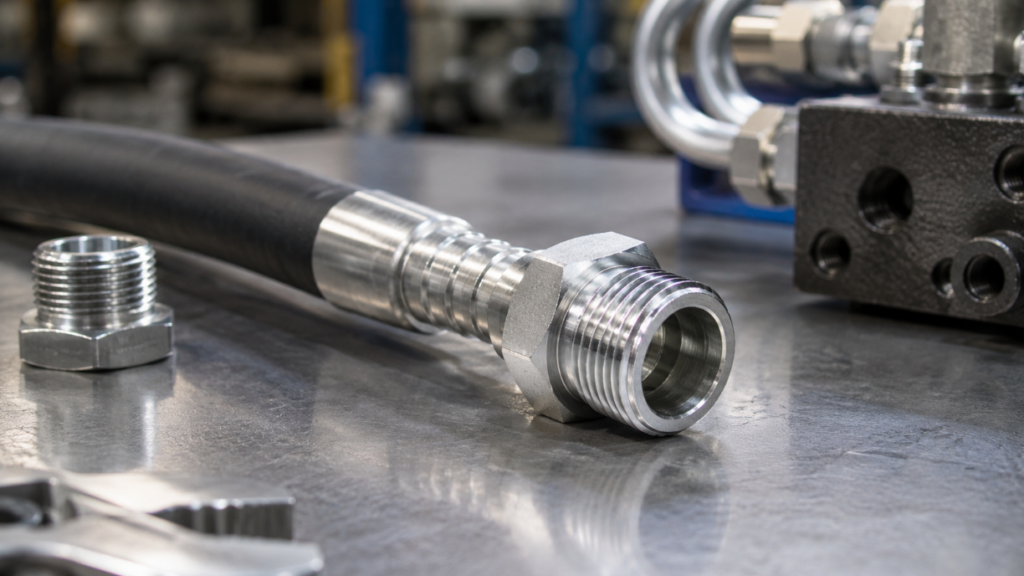
1. Visual Inspection: Tapered Threads Vs. Parallel Threads
The first step is always to determine the profile of the thread. This distinction is crucial because it directly determines how the joint is sealed under high pressure.
Tapered Threads: Like NPT or BSPT, threads are sealed by pressure generated by interference between metals when tightened. Look through it with the naked eye and you’ll see that the diameter of the thread decreases as you go towards the end.
Parallel Threads: Also called “straight threads”, their diameter remains constant from beginning to end. This thread itself is not responsible for sealing, but relies on the O-ring or the machined seat angle to resist pressure.
2. Accurate Diameter Measurement
After I’ve sorted out the thread types, I pull out a precision digital caliper to get the exact number. If this place is even a little off, there could be a catastrophic oil spill behind it.
Male connector: Measure the outer diameter by aligning the caliper jaws with the widest part of the thread.
Female connector: Insert the inner claw of the caliper into the connector, stretch it out and measure the inner diameter between the threaded tooth cusps.
Technical reminder: It is best to record both millimeter and inch data. I’ve seen too many cases of metric and SAE standards being confused because they look so similar that without careful testing they look almost identical but are definitely not interchangeable.
3. Identifying Tooth Spacing Using Thread Gauges
Here “tooth pitch” refers to the distance between the tips of the threads, or how many teeth per inch there are.
US Standards: We usually count how many teeth are within an inch of a length.
Metric standard: Directly measures the actual number of millimeters between two adjacent cusps.
On site, you have to snap the thread gauge onto the threads to see if it will fit “tight fit”. If light can still be transmitted between the teeth and threads of the dental gauge, it means that you have found the wrong standard 80% of the time. For example, mistaking a 1.5mm metric tooth for a 16-tooth American tooth is a low-level error that is not uncommon in actual operation.
4. Identify Sealing Surface Angle
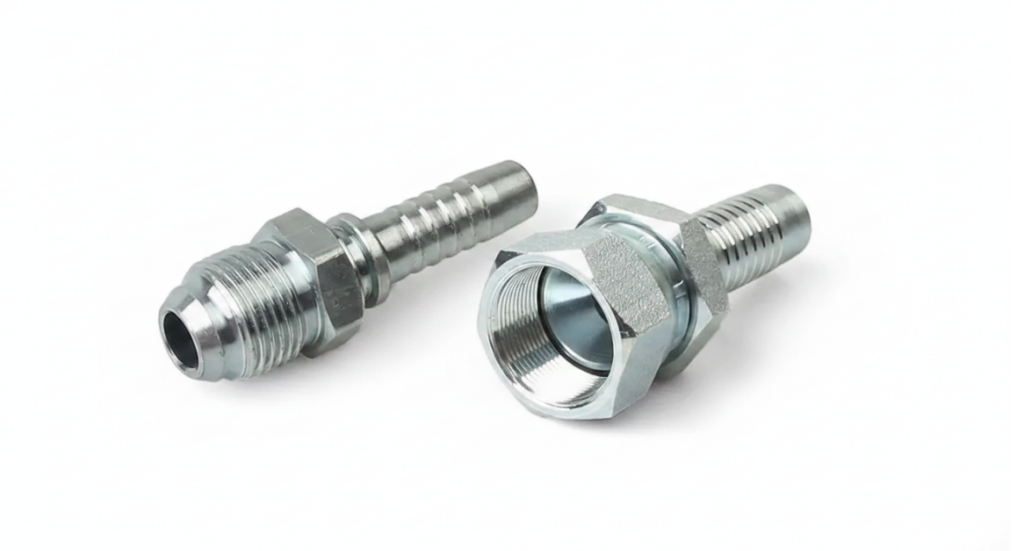
The so-called “seat surface” is where the hydraulic fluid is actually blocked. Even if the thread size is matched, if the seat angle is not aligned, it will still collapse after pressing up.
JIC 37° vs SAE 45°: The two brothers look almost indistinguishable to the naked eye. I strongly recommend that you use a seat angle gauge to measure the angle of the cone.
ORFS: This is more recognizable because it seals against an elastic O-ring embedded in a flat surface.
International standard docking: This step is very critical for comparing with international specifications such as BSPP, DIN or ISO, and can ensure that the replacement parts you buy fully comply with the original factory safety specifications.
About Dash Size Conversion And Security Benchmarks
The final step in the technical process is to convert the raw raw data you measure into Dash Size. In hydraulic circles, we are used to communicating with this abbreviation in increments of 1/16″, which is extremely efficient. For example, if the measured joint is 1/2″, we will directly write it as -08.
Author: Mark Thompson
My work at JIANGRU is driven by a commitment to technical excellence and customer-centric service, where I translate complex international standards into actionable insights for maintenance teams and procurement professionals worldwide. I believe that in the world of hydraulics, safety and reliability start with a single, perfect measurement.”ts of 1/16″, which is extremely efficient. For example, if the measured joint is 1/2″, we will directly write it as -08.
In my opinion, the accuracy of measurement is the bottom line for industrial safety. As long as this four-step identification method is strictly implemented, procurement personnel can ensure that every component they receive has impeccable reliability. We insist on high standards of technical details and precision testing, to put it bluntly, so that every connection of yours can operate stably in the harsh high-pressure environment, not drop the chain, and protect your equipment assets.
Author: Mark Thompson
Throughout my career, I have specialized in the diagnostic and manufacturing phases of high-pressure systems, focusing on precision-engineered solutions that prevent costly industrial downtime. My work at JIANGRU is driven by a commitment to technical excellence and customer-centric service, where I translate complex international standards into actionable insights for maintenance teams and procurement professionals worldwide. I believe that in the world of hydraulics, safety and reliability start with a single, perfect measurement.”


 English
  Spanish
  French
  Chinese